Author: Andrea Delgado, Community Scientist
We gathered for our quarterly community field day at seven o’clock in the morning on Saturday, November 16th at the North Shore Beach & Yacht Club. We assembled to set up on the shore of the northern end of the Salton Sea. Meanwhile, at a different site, our boat team was preparing to venture out onto the lake to collect water samples at the designated sites and transects. Alianza’s community science group for the day consisted of Alianza staff, youth, community scientists, and university researchers.

Early on, we noticed the marina in front of the community center had drastically decreased in water levels since our last field day in February 2024 and subsequent trips to the sea to do maintenance checks on instruments currently deployed. Birds were visible in the water, as Audubon conducted a routine bird survey and other visitors nearby enjoyed recreational activities. Unlike previous field days, the Salton Sea and the mountains across from us were clearly visible, reminding us of the broader significance of our work. Together, we recognize the vital role of community-led efforts to monitor the lake’s changes as it continues to recede. The actionable data we collect for water and air quality made available through our SSET dashboard aims to amplify and uplift voices from affected communities.
Our onshore team unloaded our equipment, including a photometer for nutrient testing, a Jerome sensor for measuring hydrogen sulfide, a turbidity meter for assessing water clarity, a refractometer, and YSI probe for gauging salinity. We began testing water samples from the nearby marina. We collaborated closely, following our protocols to clean vials, filter water, create sample blanks, test duplicates, prepare necessary dilutions, and document pollutant concentrations. Meanwhile, the group with the Jerome sensor highlighted the reality of our environment, revealing hydrogen sulfide levels above the safe threshold (state standard set by CARB of 30ppb) on the lakebed, even in light winds.
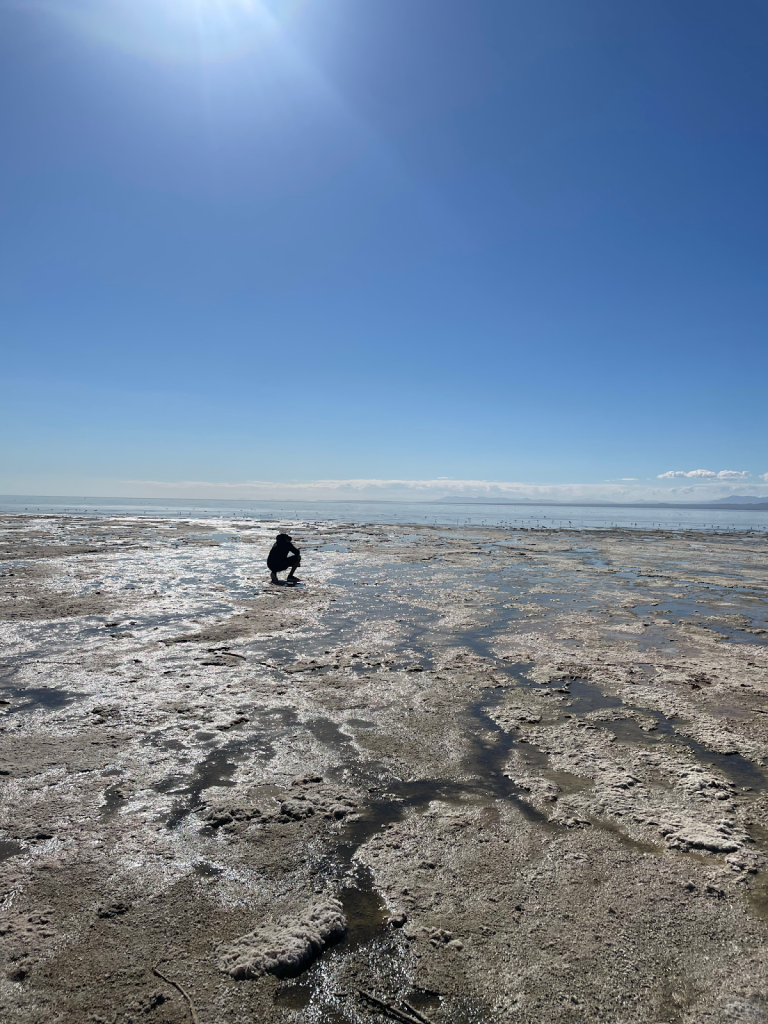
Some time later, the boat team returned. Transporting our samples to our onshore station proved challenging as Quinn Montgomery, part of the team on the boat responsible for handing off water samples to the team on the shore, sank deeper into the soft playa. It took over half an hour to reach dry land—our longest record to date. Once the samples arrived, our nutrient testing efforts accelerated as we followed protocol to examine all seven sampled sites across the lake. While high salinity and nutrient levels can support biodiversity, they risk further deterioration of water quality due to algal blooms that deplete dissolved oxygen. We set aside samples for collaborators at the University of San Diego and the Claremont Colleges, key allies in our efforts. By three o’clock in the afternoon, we ended for the day as we debriefed and shared insights from our fieldwork, looking forward to our next gathering as we parted ways.
Through our experiences, we enjoy fostering community in this shared space and viewing the Salton Sea with hope and positivity. The dedication of this close-knit community is evident in our collective monitoring efforts that address gaps left by state and federal agencies. There remains a critical need for actionable scientific research to address prevalent hazards and advocate for real change. We also recognize the need for infrastructure, funding, collaboration as well as improved water management, dust control, regulated inflow, habitat and recreational investments, and so on.
Prioritizing Salton Sea restoration efforts is crucial. Safeguarding the sea and enhancing public health is especially important for environmental justice. Every field day presents new challenges, but our perseverance, commitment, and hope for a thriving Salton Sea drive our community science initiatives.
To learn more about our work and the health of the Salton Sea, please visit our Salton Sea Environmental Time Series website, where you can explore our data and insights.