Author: Prisila Navarro, Community Scientist
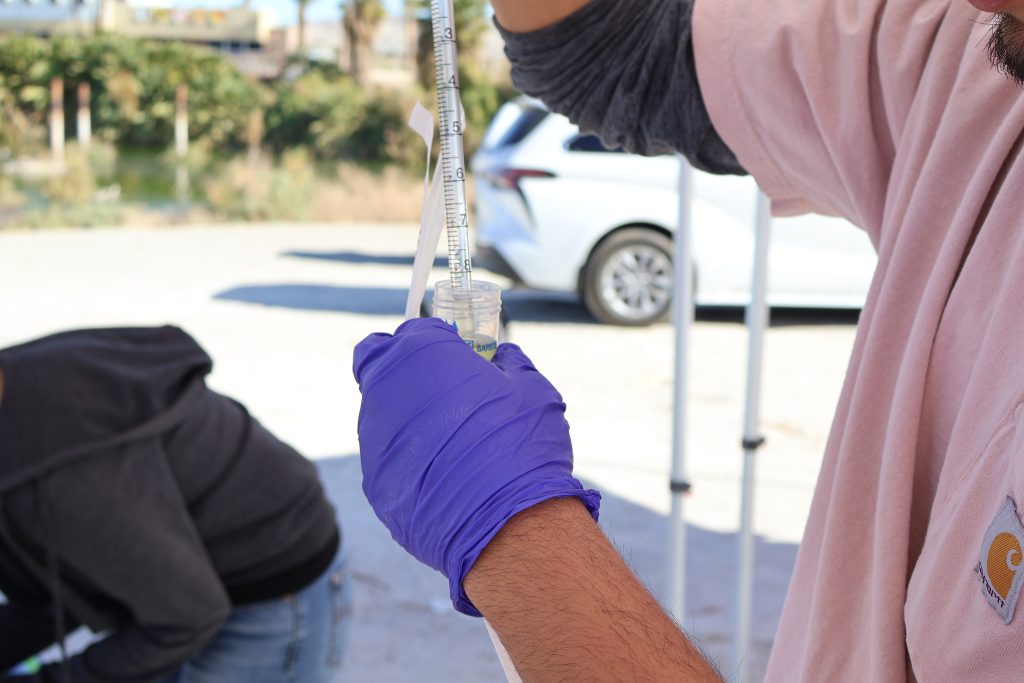
As one of the youth working on water quality testing at the community science field days, I enjoy the experience of being able to learn with my friends and other scientists. We start the day by setting up our testing area and gathering our tools so that we are ready for when the water samples arrive.
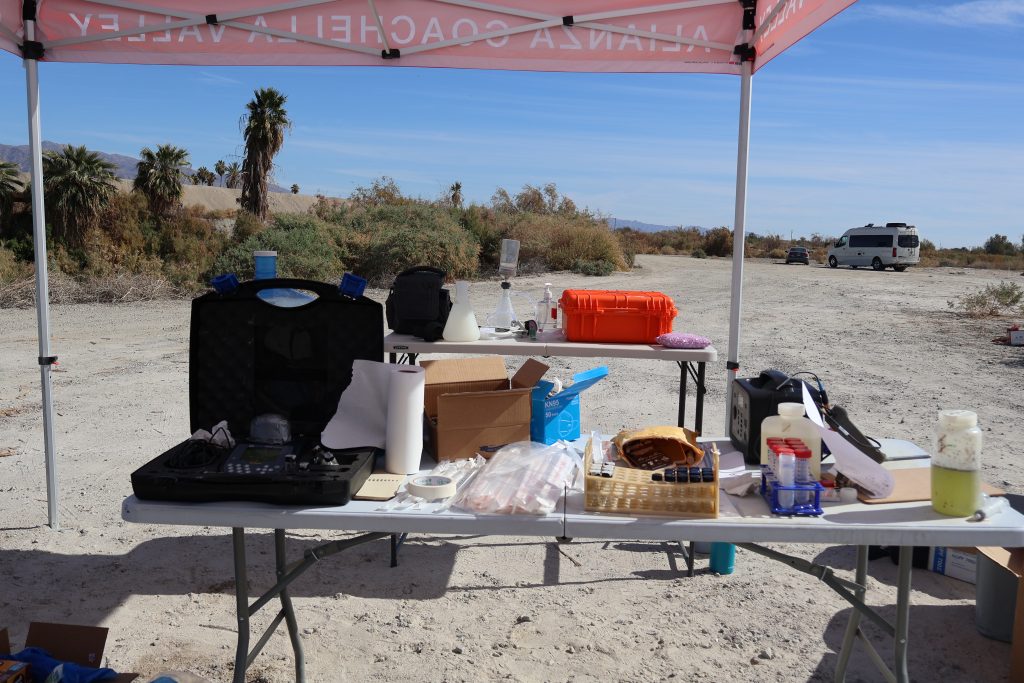
Our field days take place at the North Shore Beach and Yacht Club. During our prep time, we like to explore the surrounding areas, look out into the marina, and walk along what was once the shore of the Salton Sea. Compared to prior years, many of us have begun to notice how much water the marina has lost, almost estimating the difference between last month and this month. These observations are one of my favorite parts of water testing at the Salton Sea as I can see how much the environment has been impacted by the disproportionate amount of nutrients that the water holds. It allows me to have a visual perspective without the need to read or look at pictures but feeling and smelling the difference on my own.

Later in the day, we all separate into groups corresponding to our assigned tasks. Some people focus on testing individual nutrients, others prepare samples, others act as floaters, and so on. I’ve tested the nutrients: nitrate, and phosphate with the assistance of fellow scientists when I had any questions. Over the years, I have gained a better understanding of how to do water testing and today, I feel confident in doing the tests on my own.
One of my favorite community agreements we have is that no question is a bad question. I can ask any question, and receive an answer to every one of my confusions, whether it is small or big. One of the most interesting things I’ve learned when water testing is the need for dilutions. The reason it’s interesting to me is because it is not always necessary, so if a sample does not read or give a proper data recording, then the sample has to be diluted which means a new sample has to be taken. This can disturb someone’s tasks and can ultimately lead to frustration. However, in my experience, I have noticed that it has become a little easier to manage and our group of youth and scientists are still able to work efficiently throughout the process.
To learn more about our work and the health of the Salton Sea, please visit our Salton Sea Environmental Time Series website, where you can explore our data and insights.